
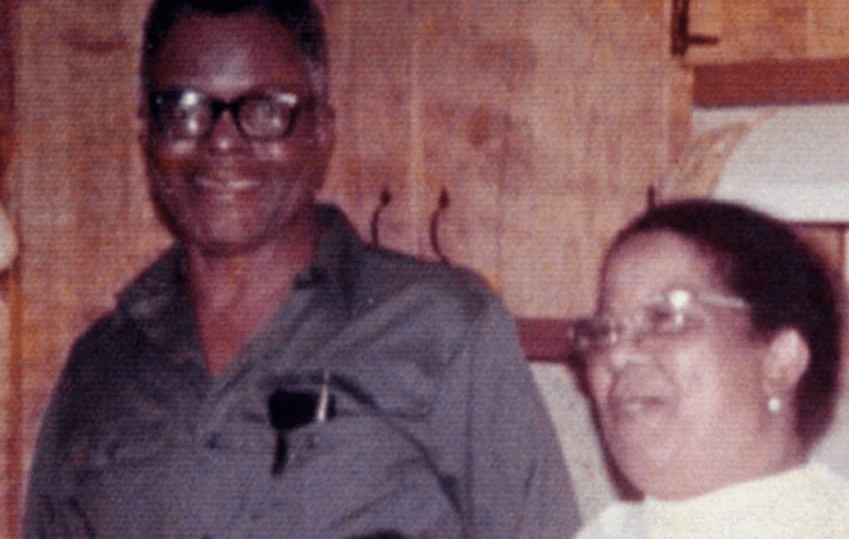
The Case of Harold and Thelma Swain — Waverly, GA (1985)
Key Details:
- Victims: Harold Swain (66) & Thelma Swain (63), beloved church leaders and community figures.
- Location: Rising Daughters Baptist Church, Waverly, Georgia.
- Date: Monday, March 11, 1985, around 9 PM.
- Crime: Both victims were shot in the church vestibule after Bible study.
- Eyewitness: Vanzola Williams spoke briefly with the unknown man before the murder.
- Suspect: Young white male, shoulder-length blond hair, wearing scuffed boots.
- Key Evidence: 5 bullet casings, 5 blue plastic buttons, 2 Pepsi bottles, cut phone lines, two pairs of glasses (one belonged to Harold, the other was a makeshift pair, likely the killer’s).
- Suspect Vehicle: Brown/orange Dodge Dart or Plymouth Duster.
- Primary Theory: Either a botched robbery or targeted, premeditated murder.
Leads & Developments:
Donnie Barrentine confessed to the crime socially but denied it during interviews. Failed a polygraph test but was never formally charged due to lack of hard evidence.
New suspect later found in Kansas crime bulletin — near-identical match to composite.
“Who Would Kill a Church Couple?”
In the quiet town of Waverly, Georgia, nestled among pine trees and swaying moss, horror visited a sacred space.
On March 11, 1985, Harold and Thelma Swain were shot and killed inside Rising Daughter Baptist Church while attending a Bible study. The killer, a white male, entered the vestibule just after 9 p.m. during a Missionary Society meeting and asked for Harold by name. Harold got up and met the man near the front doors. Minutes later, gunfire rang out.
Harold was shot four times. As Thelma ran to help him, she too was gunned down. Both died just inside the church vestibule. In the moments of chaos and grief that followed, the man fled into the dark, leaving behind a stunned community and decades of unanswered questions.
The Crime Scene
The scene was chaotic and tragic. Witnesses were mostly elderly parishioners—many of whom understandably struggled to recall clear details. But there were consistencies: the man was white, about 5’6” to 5’8”, with shoulder-length dirty blond hair, metal-framed glasses, a slim build, and a nervous demeanor. He was wearing a blue button-down shirt, dark pants, and appeared to be in his 20s or 30s.
The church was poorly lit, but some remembered seeing him earlier at Reed’s Store acting jittery and barely able to afford a Pepsi. A Pepsi bottle was later found at the crime scene.
The killer left behind a trail of bizarre evidence:
- Five blue shirt buttons from his clothing.
- Metal-framed safety glasses, bizarrely constructed from multiple pairs, designed for someone extremely farsighted with astigmatism. These glasses had welding damage and traces of transmission fluid.
- A brown Dodge Dart or Plymouth Duster was seen fleeing the scene.
- The church’s phone lines had been cut before the attack—suggesting planning.
Harold was shot once in the temple, execution-style, after collapsing from three earlier gunshots. Thelma’s final moments were spent trying to help her husband. Both victims were pillars of the church and beloved community members. Their deaths devastated not just a town, but generations of friends and family.
Despite extensive media coverage and even a segment on Unsolved Mysteries in 1988, the case grew cold. Yet the story didn’t end there.

A Disturbing Confession: Donnie Barrentine
In 1986, a year after the murders, a man named Donnie Barrentine began bragging at a party that he had killed “a Black preacher and his wife in a South Georgia church.” Three witnesses, including one with no connection to the others, confirmed this statement and said Barrentine even showed them the murder weapon.
One version of the story suggested that Harold Swain’s murder was used to lure out a stepson involved in drugs. While no such son-in-law existed, Harold’s adopted daughter’s stepfather was involved in drugs and hiding at the time.
When arrested, Barrentine was reportedly on his way to commit another murder for a cousin—who had instructed him to “cut the phone lines” first, echoing details from the Swain case. But when questioned, Barrentine claimed he had made the whole story up.
Still, there were disturbing consistencies:
- He wore boots matching the type seen on the killer.
- He failed a polygraph test and was described by the examiner as “a very good suspect.”
- His work log placed him on the job March 11 and 13—but not March 12, the day of the murders.
One witness in a lineup noticed his boots but couldn’t positively ID him. Authorities ultimately dismissed the confession as unreliable, and Barrentine was never charged. He later served time on unrelated weapons charges.
A Haunting Sketch in Kansas
Later, Agent Joe Gregory—a lead investigator and former GBI agent—discovered a composite sketch in a Kansas police bulletin that perfectly matched the Waverly killer. The Kansas man was wanted for burglarizing churches and once asked a priest for gas money—eerily similar to how the Swain killer had approached Harold.
The Kansas suspect drove an older vehicle with Florida tags. Unfortunately, he was never identified or found. But the matching sketch continued to haunt Agent Gregory.
He began to suspect that the Swains’ killer may have been a transient who targeted churches, possibly for robbery. Gregory still believes this today.
The Arrest and Trial of Dennis Perry
Perry was arrested in 2000 and charged with the murders based primarily on the testimony of Jane and Carol Ann. Prosecutors leaned heavily on their statements, despite a glaring lack of physical evidence linking Perry to the scene.
There were serious issues with how the identification process was handled. Two eyewitnesses—Cora Fisher and Vanzola Williams—identified Perry as the man they saw that night, but only after being shown a single photo of him by Sgt. Randy Bundy and Jane Beaver, respectively. This occurred 13 years after the murders, and neither woman identified Perry in court. Cora’s identification happened after she had fallen and was awaiting an ambulance—an admittedly stressful and chaotic setting.
At trial, the prosecution dismissed the glasses found at the scene as irrelevant, despite them being a key physical clue. DNA testing later showed the hairs found on the glasses did not match Perry’s. An eye exam confirmed Perry had 20/20 vision and no need for the type of prescription those glasses were fitted for.
Moreover, Perry had an alibi—his boss at the time said he was at work during the murder. Unfortunately, by the time of the trial, the company had shut down, and the employment records were no longer available. His defense attorneys also pointed out the unreliable nature of the eyewitness descriptions, inconsistencies in the suspect’s appearance, and the cross-race effect—when people struggle to identify individuals of a race different from their own, which was relevant in this case since all the witnesses were Black and the suspect was white.
Despite these inconsistencies, Dennis Perry was convicted in 2003 and sentenced to life in prison without parole.
“I might’ve been there.”
“Maybe the gun went off. I would’ve never hurt that woman.”
“I would make it right if I could.”
He later recanted everything.
In 2003, Perry was convicted of the murders and sentenced to two life terms, avoiding the death penalty by waiving his right to appeal. He has maintained his innocence since.
Controversy and Missing Evidence
Many—including law enforcement and legal experts—have questioned Perry’s conviction.
- The safety glasses, blue buttons, and Pepsi bottle? Lost.
- Photographs and evidence logs? Gone or mishandled.
- Chain of custody? Broken, especially after Unsolved Mysteries filmed with original evidence.
Additionally, Bundy faced criticism for tunnel vision, ignoring other suspects like Barrentine and the Kansas man. The GBI never seriously investigated Perry in the 1980s. Key eyewitness identifications happened over 13 years after the murders, based on old photos, not live lineups.
Perry wrote to the Georgia Innocence Project in 2004, pleading for DNA testing and a second look. As of today, no exoneration has occurred.
A Community Still Waiting for Peace
It’s been 40 years. And still, no one can say with certainty who killed Harold and Thelma Swain.
Was it a local man with a racist grudge?
A transient church burglar from Kansas?
Or a braggart like Donnie Barrentine seeking attention—or hiding a darker truth?
Even now, Agent Gregory drives past the Rising Daughter Baptist Church every day. He says:
“I think of Harold. I think of Thelma. They didn’t deserve that. It never leaves
me.”
A Mysterious Phone Call, a Decade Later
It wasn’t until 1998 that the case gained traction again. That year, a woman named Jane Beaver contacted police, claiming that her daughter Carol Ann Sullivan’s ex-boyfriend, Dennis Perry, had once talked about killing a Black preacher. Jane later stated that she had seen a composite sketch in 1986 and immediately believed it looked like Perry. Despite this, she did not come forward for twelve years.
Carol Ann corroborated parts of the story but would later express doubts about Perry’s guilt. Jane eventually received a $12,000 reward for her tip—money she had inquired about the day after Perry’s arrest—though this was never disclosed to the defense at trial. Her mental health history, including hallucinations and delusions, was also never shared with the jury.
The Turn of the Tide: DNA, Podcasts, and the Georgia Innocence Project
Years later, the Georgia Innocence Project (GIP) began re-investigating the case, joined by the Undisclosed podcast team in 2018. GIP uncovered critical failures in the original trial and police work. The investigators had failed to record Perry’s alleged confession, even though they had a tape recorder. The only notes taken were destroyed after a brief summary was written. Other interviews, including those with Carol Ann, were also not recorded.
GIP petitioned for DNA testing of several items, including shell casings and phone wires. While these tests did not yield usable results, attention returned to the hairs found on the glasses—hairs that definitively did not belong to Perry or Barrentine, another early suspect.
Journalist Joshua Sharpe of the Atlanta Journal-Constitution took a closer look at an early lead dismissed in 1986: Erik Sparre. His ex-wife Emily had told police that Sparre had confessed to killing the Swains. He told her he was the “mother f—– who killed the two n—— in that church.” Her family had recorded the threats and played them for police, but the tape was lost. Sparre also reportedly matched the killer’s description, had a history of racist threats, violence, and mental instability, and wore glasses cobbled together from other pairs—just like the pair found at the scene.
Emily also noted that Sparre was gone the morning of the murder and returned wearing only a white t-shirt. The killer had been described as wearing dark clothing, and unidentified buttons were found at the scene. She identified the glasses found at the crime scene as one of the three pairs Sparre had made. He worked as a welder, and a torch had been used to modify the glasses.
Sparre had claimed he was working at Winn-Dixie the night of the murder, and the police had confirmed his alibi with a “Donald Mobley,” allegedly the store manager. But Sharpe discovered that this person did not exist. The phone number traced to a woman’s back shed. The actual store manager, David Mobley, denied ever speaking to police or having a Donald Mobley on staff.
In 2020, DNA taken from Sparre’s mother matched the mitochondrial DNA found in the hairs on the glasses. This evidence excluded 99% of the population and strongly suggested that the hairs belonged to Sparre or a maternal relative. With this new evidence, Perry’s attorneys filed an Extraordinary Motion for a New Trial. Judge Stephen Scarlett agreed and overturned Perry’s conviction, stating that the DNA evidence would likely have changed the outcome of the original trial.
On July 23, 2020, Dennis Perry was released from prison. In 2021, he was fully exonerated and awarded $1.2 million in compensation by the state of Georgia.
Tragically, just days after the conviction was overturned, Sparre’s mother Gladys was found dead in her home. The cause of death remains unknown.
The Arrest of the True Killer
In December 2024, nearly 40 years after the murders, Erik Sparre was finally arrested and charged with two counts of murder and two counts of aggravated assault in connection with the deaths of Harold and Thelma Swain.
Sadly, by this time, many of the key figures in the case had passed away: Vanzola Williams, Jane Beaver, and Emily Sparre. Still, justice, though delayed, had not been denied.
A Legacy of Resilience
This case is a harrowing example of the failures and flaws within the justice system—where weak evidence, racial bias, prosecutorial omissions, and unreliable testimony led to the imprisonment of an innocent man for nearly two decades. It is also a story of persistence: from the dogged efforts of journalists, activists, and the Georgia Innocence Project, to the long-silenced voices of women like Emily and Carol Ann, who eventually helped bring the truth to light.
Harold and Thelma Swain’s memory lives on, and with the arrest of Erik Sparre, there is finally hope that their souls, and those left behind, may find peace.
There are cases that linger in the air like the smell of pine and sorrow. This is one of them.
If you know something—say something. Even whispers can become answers.
Much love and many blessings,
Mrs. B
#SwainMurderCase #JusticeForTheSwains #WrongfulConviction #DennisPerry #ErikSparre #GeorgiaInnocenceProject #TrueCrimeCommunity #ColdCaseSolved #InnocenceProject #JusticeServed #CriminalJusticeReform #TrueCrimeStory #UndisclosedPodcast #MiscarriageOfJustice #FaithAndJustice #ChurchMurders #DNAExoneration #JusticeDelayedNotDenied
Discover more from LunaOwl : The Unconventional Momma
Subscribe to get the latest posts sent to your email.
