Who is Cernunnos?
Cernunnos (pronounced Ker-noo-nos or Ser-noo-nos) is a powerful, enigmatic deity often referred to as the “Lord of the Wild Things” or “Horned God.” His image has appeared across ancient Celtic iconography, most famously on the Gundestrup Cauldron—a silver vessel dating back to the 1st century BCE. While little written mythology remains due to the oral traditions of the Celts, his symbolic presence is clear: he is a guardian of nature, the forests, fertility, animals, and the cycles of life and death. Emphasizing his role in the natural order, Cernunnos is often depicted surrounded by various creatures, representing the interconnectedness of all life. This highlights the ancient Celts’ reverence for the wilderness and their understanding of the balance that must be maintained within the ecosystem. Additionally, Cernunnos is associated with prosperity and abundance, signifying the importance of nature’s bounty, which provided for the sustenance and well-being of the people. His worship likely involved rituals aimed at ensuring fertility of the land and livestock, embodying the deep spiritual connection the Celts had with the earth and its cycles.
His Cultural Roots
Cernunnos is most commonly associated with Celtic polytheism, especially in Gaulish and Brythonic traditions. This deity represents fertility, life, animals, wealth, and the underworld. While the Celts did not leave behind organized pantheons like the Greeks or Romans, Cernunnos is believed to have been widely venerated across the Celtic world. His influence extends beyond geographic boundaries, suggesting that his worship may have spread through trade and cultural exchanges among different Celtic tribes.
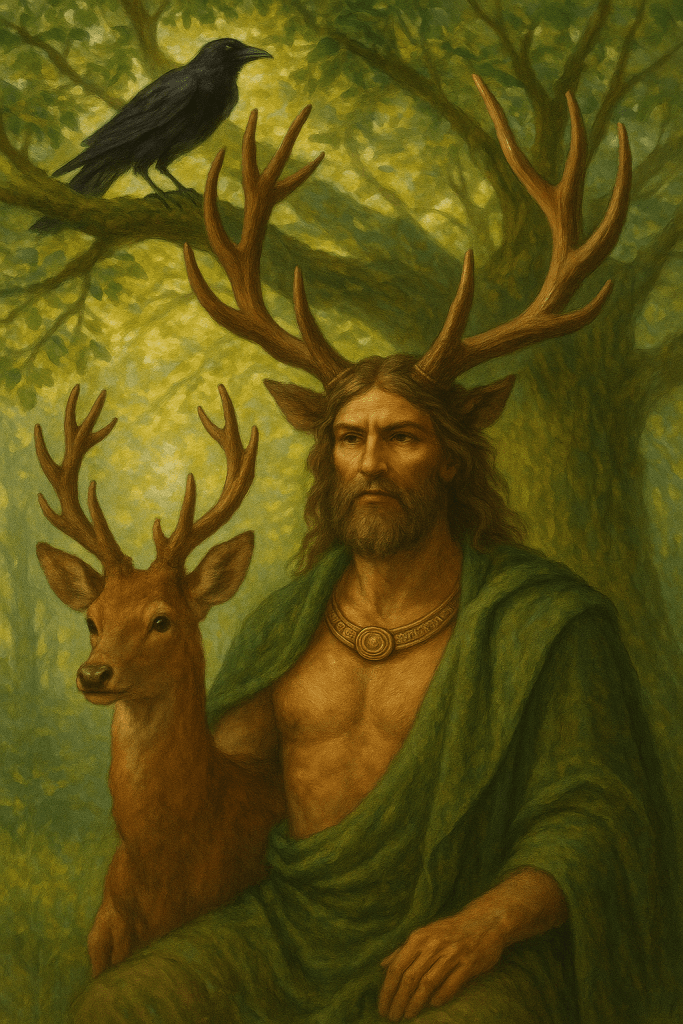
The singular mention of his name in writing occurs on a pillar found in Paris (then known as Lutetia), where it is inscribed alongside images depicting his features. However, it is his image that has proved to be more enduring in the collective memory of cultures influenced by Celtic mythology. He is typically depicted as a calm-faced man with stag antlers, seated in a cross-legged or meditative pose, embodying a sense of peace and connection to nature.
Often, Cernunnos is portrayed surrounded by wild animals, symbolizing his dominion over wildlife and his role as a protector of nature. Additionally, he is sometimes seen holding a serpent with ram’s horns, which could signify duality—of life and death or healing and malice. This complex iconography suggests that Cernunnos played a significant role in the spiritual lives of the Celts, representing not only their reverence for nature but also their understanding of the cycles of life, and the balance between the seen and unseen worlds. The absence of extensive written records about him further adds a layer of mystery to his character, inviting interpretation and exploration within modern paganism and Celtic revival movements.
Symbols and Associations
- Antlers: Representing strength, growth, and his deep connection with the stag and the forest, the majestic antlers are a symbol of not only wildlife resilience but also the ongoing cycle of nature and the intricate balance maintained within forest ecosystems.
- Torc (Neck Ring): A Celtic symbol of nobility, wealth, and spiritual authority, often crafted from precious metals or decorated with intricate designs. It was worn as a status symbol by Celtic nobility and is believed to have held significant spiritual meaning, representing the connection between the physical and spiritual realms.
- Animals: Stags, wolves, serpents, bulls, and other woodland creatures often accompany him, creating an atmosphere of mystery and enchantment in the forest while also symbolizing the various aspects of nature and the primal instincts that dwell within.
- The Wheel of the Year: He is often seen as the consort or counterpart to the Goddess, embodying fertility in spring/summer and sacrifice/rebirth in autumn/winter, representing the ever-turning cycles of nature and the powerful connection between life and death. His figure serves as a reminder of the balance between creation and destruction, highlighting the importance of harmony within the natural world.
Honoring Cernunnos
Cernunnos is best honored in natural settings—a forest, meadow, or even your backyard garden. He doesn’t demand elaborate rituals but instead asks for authenticity and a heartfelt connection with the wild.
Ways to Honor Him:
- Create a natural altar: Decorate it with antlers, pinecones, feathers, moss, stones, or bones (ethically sourced).
- Celebrate Sabbats: Particularly Beltane (life and fertility) and Samhain (death and rebirth).
- Tend the Earth: Plant trees, care for wildlife, practice sustainable living.
- Wander the Wilds: Go for mindful hikes or forest walks and leave small offerings like herbs or stones.
Offerings He May Enjoy
Cernunnos is a deity of the land and the hunt—he values reciprocity, respect, and wild beauty.
Suggested Offerings:
- Acorns, chestnuts, or dried berries
- Wine, mead, or cider
- Antler pieces or animal figurines
- Torcs or copper coins
- Fresh spring water
- Wildflowers or foraged herbs like mugwort, vervain, or oak leaves
Working with Cernunnos
To work with Cernunnos is to embrace your instinctual self, your connection to the animal world, and the sacred rhythm of nature. He encourages us to find balance between the civilized and the wild, and to remember that death is not the end—merely part of the cycle.
Ways to Connect:
- Meditate in nature: Sit quietly and listen for his energy—often calm, grounding, and deeply primal.
- Shapeshifting Journey Work: Visualize walking through the forest and encountering him in animal form.
- Shadow Work: Cernunnos supports diving deep into your instincts, desires, and fears without judgment.
How to Call on Him
Begin with reverence. Speak from the heart. You do not need to be Celtic or follow reconstructionist paths to build a relationship with him—he meets you where the forest begins.
A Simple Invocation:
“Cernunnos, Lord of the Wild Things,
Guardian of beasts and keeper of cycles,
I call to you with open heart and grounded feet.
Guide me through the tangle of branches and bones,
Show me the wisdom of the forest and the truth in my wild soul.
So may it be.”
Light a green or brown candle, sit barefoot on the earth if possible, and feel your heartbeat align with the drumbeat of the woods.
A Personal Note from Mrs. B 🌲
As I’ve shared before, my deities often come to me in pairs—one boldly, the other with a softer presence, giving me space to adjust and grow spiritually without becoming overwhelmed. Recently, The Morrígan called to me with her fierce, shadowed grace. Not long after-[Today as a matter of fact], I felt the quiet, steady pull of Cernunnos, rising from the deep forest floor and brushing against my spirit like wind through ancient trees. I have always been drawn to them if I am honest.
To me, Cernunnos feels like a natural counterpart to The Morrígan—two sides of the ancient wild, both guardians of life, death, and the in-between. Where she stands at the battlefield’s edge, he waits deep in the woods. Together, they represent a divine duality that speaks to the cycles we all live through: strength and surrender, chaos and order, decay and renewal.
What’s even more profound for me is that I’ve also always been deeply drawn to ravens, black birds, stags, hinds, and the presence of antlers or bones—long before I understood why. These symbols have been ever-present in my dreams, my artwork, and my spiritual path.
Interestingly enough, my birth surname—Hatton—comes from a house associated with the stag or sometimes a hind. It’s as if the wild has been whispering to me since the beginning, and now I’m finally listening with open ears and heart.

The Hatton surname in Ireland carries both English and Gaelic origins, with some families arriving as settlers during the medieval period and others possessing deep Gaelic roots. The name is most often linked to County Wexford, with variations like Hattin, Hatten, and Haddon appearing across regions. The Gaelic derivation may come from Mac Giolla Chatáin, meaning “servant of (Saint) Catan.”
The Hatton coat of arms is a rich tapestry of symbolism:
Azure (a deep blue field), with a chevron between three gold garbs (sheaves of wheat), and marked by a red annulet(ring). The crest features a hind statant or, a golden female deer, charged with the same red ring. The family motto, “Virtus tutissima cassis,” translates to “Virtue is the safest helmet” or more poetically, “A virtuous man is safe from danger.”

Or as seen on the left: The Latin phrase “Nil conscire sibi” translates to:
“To be conscious of no wrong in oneself”
or
“To be aware of no guilt within”
Breakdown:
- Nil = nothing
- Conscire = to be conscious or aware (especially of wrongdoing or guilt)
- Sibi = to oneself / within oneself
This phrase is often used to express a clear conscience—the state of having no guilt or wrongdoing on one’s soul. It’s notably part of a longer line from the Roman poet Lucan:
“Nil conscire sibi, nulli pallescere culpae”
“To be conscious of no guilt, and to turn pale at no accusation.”
It’s a beautiful, stoic phrase that aligns well with spiritual integrity, inner peace, and virtue.
As a locational surname, Hatton likely referred to someone from a “heath farm or settlement.” And yet, within that grounded meaning lies the wild heartbeat of the land—stag, hind, wheat, and virtue bound in bloodline and spirit.
My ancestors, it seems, have once again been guiding me home. In 1901, there were 237 people with the Hatton surname in Ireland, ranked 2299th in the country at the time. Murphy, the most common surname, was ranked 1st. But Hatton, humble and tied to the wild, was ours, my family was one of those who made the journey to Ireland, their stories, symbols, and spirits now awakening in me as I walk this path with eyes wide open.
Much love and many blessings,
Mrs. B 🌲🖤🦌🪶
Discover more from LunaOwl : The Unconventional Momma
Subscribe to get the latest posts sent to your email.
